Educational Resources
Welcome, educators! Phoebe Gilman's books offer wonderful opportunities for teaching and learning. Here you'll find comprehensive lesson plans, activities, and resources to bring these beloved stories into your classroom.
Activities for All Books

Activity #1: Each new book has small pictorial references to all the previous books hidden in it. If students are taught to look at the information printed in the ‘front matter’ of each book, this can be the springboard for many lessons:
- Sequencing, which books came first, second, etc?
- How many books are hidden in a specific book?
- Which books are not hidden in a specific book?
- Photocopy a grid using lucite paper. Letter the vertical lines, number the horizontal ones. When a student locates a hidden picture, he writes the book’s title, copyright date and page number. Then he defines the hidden picture’s location by placing the grid over the page and giving the proper coordinates. (This suggestion courtesy of Pauline Beder, an incredibly gifted teacher/librarian with the York Region District School Board in Toronto.)
- More or Less. Which books have more pictures hidden in them? Which ones have less? Which have the most? The least? Do any have an equal amount? Does any book have none?
Activity #2: If a book has a villain in it, create “wanted” posters. On a sheet of paper draw an open square. Print “wanted” above it and draw lines below it with the words: name, description, crime, last seen, reward. The students draw a picture of the ‘bad guy’ and fill in the blanks below. Story-telling can be encouraged by asking them to describe how the villain came to his/her life of crime. Could he possibly be reformed? How?
Activity #3: Read the book aloud up to a crisis point. The students invent their own solutions. This can be either a written or oral lesson.
Activity #4: One student pretends to be a newspaper reporter interviewing one or more characters from the book. This can be done in the form of play-acting or as a written assignment to create a newspaper article. A large sheet of paper can be used imitating a newspaper front page. Student work, with headlines, can be attached to this for display.
Activity #5: Two students choose characters from the same book or different books and invent a conversation between them.
Activity #6: Pair students. Each chooses a character and in that role writes letters to the other.
Activity #7: Classification: From a list of words, choose which best describe different characters in the book.
Activity #8: Create a mural based on the story.
Activity #9: Estimate: How many words/sentences/lines on a page.
Activity #10: More or Less: Which page or book has the most sentences in it?
Activity #11: Long & Short: Find the longest word on a page. Find the shortest word. Count the letters in each. Subtract one from the other. How many more letters did the larger one have?
Activity #12: Create a timeline that shows the order in which the events in the story happened.
The Balloon Tree
Activity #1: Using colored paper, create a large tree. Written work is glued on to balloon shaped colored paper and tacked onto the tree. Suggestions:
- Write your own magic words.
- Favorite part of the story.
- If I had a magic tree...
- Pretend to be the Archduke in prison. Write a letter to the King or Princess Leora, complaining about conditions and asking for freedom.
Activity #2: Photocopy sheets of paper with synonyms and antonyms placed inside of balloons. Students draw strings to connect corresponding balloons.
Activity #3: Do a unit on the Middle Ages
Activity #4: Try writing calligraphy. (Stationary stores sell inexpensive felt calligraphy pens.)
Activity #5: Tack real balloons onto a fake tree. Add and subtract balloons. Sort by colour, shape, or size.
Activity #6: Students share the balloons. Does each wind up with an equal amount? Are there any leftover?
Activity #7: Estimate: how many balloons tall is a student? Check answer by having the student lie down to be measured.
Activity #8: Estimate with a string, the circumference of various balloons. How close was the estimate? What happens if air is let out of a balloon or added to one?
Jillian Jiggs

Activity #1: There are many questions that can arise in this book, which make great written and oral exercises. Suggestions:
- I like to dress up as ———- and ———-.
- What did Jillian’s Dad say or do when he came home?
- Jillian’s Mom is talking to Rachel’s Mom. What do they say?
- What did Jillian say to herself when she looked in the mirror?
Activity #2: Print a key word on the blackboard and invite students to suggest words that rhyme with it. Working together, create a four-sentence story. Each sentence must end with one of the rhyming words on the blackboard.
- 1st sentence: Introduces a person, place or thing with a problem.
- 2nd sentence: Shows the subject beginning to solve the problem.
- 3rd sentence: Presents an obstacle to solving the problem.
- 4th sentence: The solution to the problem.
Little Blue Ben

Activity #1: Have students draw a picture and hide things in it. How many things are hidden?
Activity #2: Place cut out blue paper eggs in a basket (or dyed real ones). There are many possible ways to use this:
- Add and subtract eggs.
- Estimate how many are in the basket.
- Using two baskets, which has more or less?
- Sorting using eggs of different size or colour.
Activity #3: Compile a class cookbook having students invent recipes for blue eggs.
Activity #4: Rhyming words are written on paper cut-out eggs. Children sort the words that rhyme into the appropriate baskets.
The Wonderful Pigs of Jillian Jiggs
Activity #1: Adding, subtracting, and multiplying pigs. This can be done using pink paper cut out pigs or- for the really ambitious- stuffed, sewn pigs. Examples:
- If each pig cost 10 cents, how much money would Jillian make if she sold 3 pigs?
- If Rachel made 5 pigs and sold 2, how many would she have left?
Activity #2: Sorting pigs: As above, only students sort the pigs by colour, size or other distinguishing characteristics.
Activity #3: Start as above, then have students divide pigs up. How many do they each get? How many are left over? Does someone have more or less?
Activity #4: Have a pig-nic. Suggestions: Ham sandwiches, pigs in blankets, etc.
Activity #5: Collect sayings derived from pigs. For example: Go hog wild. Pig out.
Activity #6: Make stuffed pigs following instructions at the back of The Wonderful Pigs of Jillian Jiggs book. A word to the wise: don’t attempt this without classroom helpers. Once students have created their pigs, have them create an environment for them using a shoebox. For instance, a space pig’s box could be covered with aluminum foil to resemble a space ship or a strange planet with 3 moons. A vampire pig could live in a cave. Then have students write or tell a story about their pigs.
Grandma and the Pirates
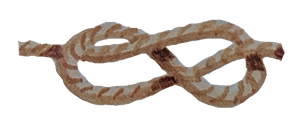
Activity #1: Collect stories, songs, and poems about pirates and/or the sea.
Activity #2: This book can be incorporated into units on:
- The ocean
- Macrame
- Real and imaginary sea creatures
- Real pirates
Activity #3: Learn how to tie knots and the names of the sailor’s knots used on the borders of Grandma & the Pirates.
Activity #4: Write how the pirates could escape from Boola Boola.
Activity #5: Draw treasure maps and organize scavenger hunts using them. Instructions involve math. Take three steps forward, ten to the right, etc.
Activity #6: Make a treasure chest and fill it with gold chocolate coins of varying sizes, or colored beads of varying shapes, colours and sizes or painted macaroni coins and jewels, noodle necklaces and bracelets. This can be used for all kinds of math exercises: counting, adding, subtracting, estimating, sorting, sharing, etc.
Activity #7: Geography: Where would the pirate ship sail?
Activity #8: Make Pirate Food. This involves measuring and following instructions:
Grandma’s Noodle Pudding
Ingredients:
1 package of broad egg noodles
¼ cup melted butter
4 large eggs
½ cup sugar mixed with cinnamon
½ teaspoon vanilla
1 cup of raisins
1/8 teaspoon salt
¼ cup brown sugar
Directions:
Cook the noodles till tender. Rinse and drain.
Beat eggs. Add butter, sugar, cinnamon, vanilla, raisins, and salt.
Fold mixture into noodles and pour everything into 9 x 13 pan.
Sprinkle with brown sugar and cover with foil.
Bake 30-45 minutes in 350 degree oven.
Cut into squares and serve hot or cold.
Once Upon a Golden Apple
Activity #1: Students write their own mixed up stories.
Activity #2: Students invent a beginning and end to any of the wrong answers. For example: Explain how the princess came to be kissing a reluctant dragon and what happened after she did that.
Something from Nothing
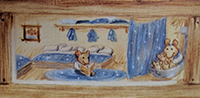
Activity #1: From a large piece of blue paper, cut out the things that Joseph’s Grandpa makes for him. Shuffle them and ask the children to place them in the correct order.
Activity #2: Tell the story while cutting the shapes out of a large rectangle of blue paper. Children take the paper scraps and cut their own creations out of the bits that are leftover.
Activity #3: This book can be incorporated into units on:
- Life in the old Jewish shtetls
- Recycling
- Folktales
Activity #4: Compare various versions of traditional folktales.
Activity #5: Have students ask their parents or Grandparents to tell stories from their childhood.
Activity #6: Tell or write the mouse story.
Activity #7: A lesson on the concept of zero/nothing.
Activity #8: A lesson on the Sabbath
Activity #9: Students bring in a treasured object and tell the story of what makes it special. Where did it come from? How is it used? Etc. These stories can be real or imaginary.
Activity #10: Invite Cascade Theatre in to show their award-winning play based on Something From Nothing.
Jillian Jiggs to the Rescue
Activity #1: Make monster masks using paper plates, cups, strings, bottle caps, etc. Count how many bottle caps/strings etc. were used to make a mask.
Activity #2: Pretend you are the monster in Jillian’s monster machine. What would you say to her?
Activity #3: Make a monster machine using cardboard boxes.
Activity #4: Have students draw a picture of a nightmare they’ve had. Suggest that they also draw in helpers, for instance: a magic wand, an invisible cloak, a fairy Godmother, a magic pebble. Next they draw in a barrier to protect themselves. For instance: a cage around the nightmare subject, a deep hole, a high wall etc. Once this is done, they write or speak a conversation with the nightmare subject including the nightmare subject’s response.
The Gypsy Princess

Activity #1: Write or tell the story from the bear’s point of view.
Activity #2: Write or tell a story beginning with: When I gazed into my crystal ball, I saw….
Activity #3: Draw a picture of Cinnamon dressed in pantaloons and camisole. On separate pieces of coloured paper cut out different coloured crinolines. Add or subtract crinolines. Example: If 2 crinolines were removed, what colour would be left showing?
Activity #4: This book can be incorporated into units on:
- The real Romany
- Bears
- The forest
- Wild herbs
- Trees/plants
- Castles
Activity #5: Ask students to write or tell about something that makes them different. Ask them to re-think those differences. How do differences make people more interesting. Isn’t everyone special in some way?
Activity #6: Write on the subject: There are things more precious than a crown of gold.
Pirate Pearl

Activity #1: Draw treasure maps and organize scavenger hunts using them. Instructions involve math. Take three steps forward, ten to the right, etc. etc.
Activity #2: Make a treasure chest and fill it with gold chocolate coins of varying sizes, or colored beads of varying shapes, colours and sizes or painted macaroni coins and jewels, noodle necklaces and bracelets. This can be used for all kinds of math exercises: counting, adding, subtracting, estimating, sorting, sharing, etc.